PHP & Laravel development

Security fixes still supportedLaravel and plain PHPWritten audit reportCode in your repository
Audit first
Before any change
Audit first
Before any change
PHP 8.3+
Supported versions only
Tests
Around what matters
You own
Code, repo & servers
Problems we fix

Versions01

Stuck on a PHP version with no security fixes

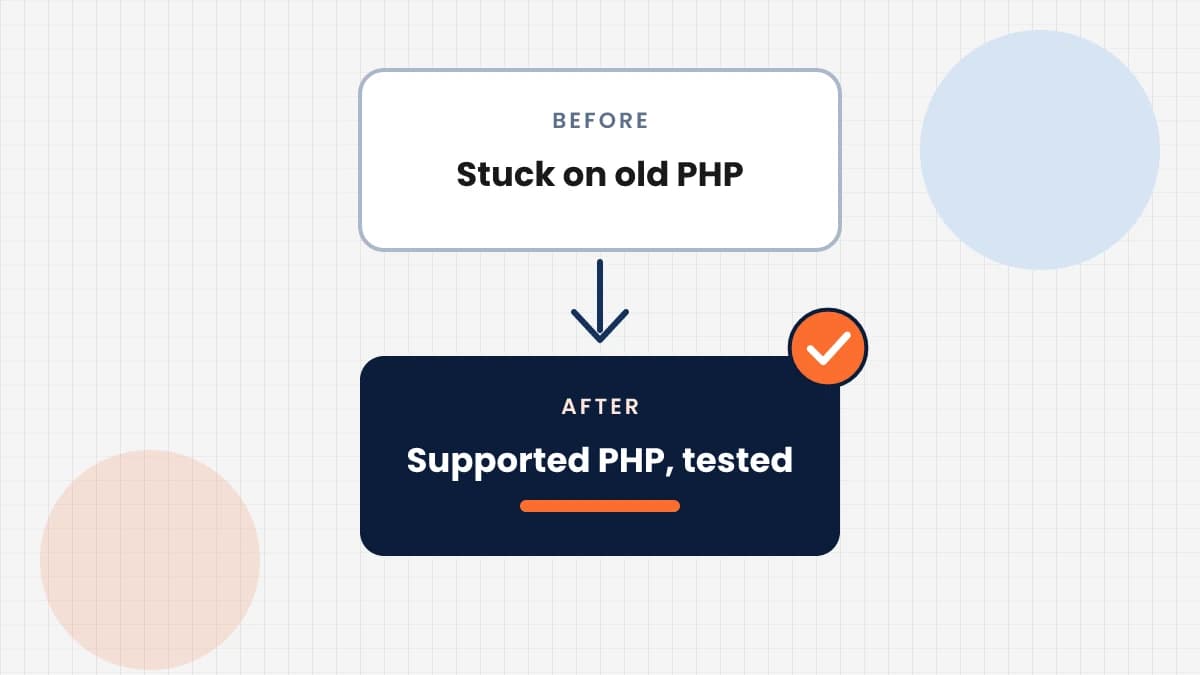
Many business apps still run on PHP versions that php.net no longer patches. We audit the code, fix what newer PHP breaks, and move you to a supported version on staging first.
Maintainability02

Code nobody wants to touch

Old PHP without tests or structure makes every change risky. We add tests around critical features and move logic into a clean Laravel structure, piece by piece.

Takeover03

The original developer is gone

When the agency or freelancer who built the app disappears, nobody knows how it works. We get it running on a copy, map features and data, and write it all down.

  • Running copy of the app
  • Feature and database map
  • Risk report
Packages04

Abandoned packages block the upgrade

Libraries that stopped being maintained often break on newer PHP. We find them, replace them with maintained ones or small in-house code, and test the result.

  • Dependency inventory
  • Replacements chosen
  • Regression tests
Framework05

An old Laravel version

Each Laravel release gets two years of security fixes. We plan major upgrades as routine maintenance instead of a crisis every few years.

  • Upgrade plan per release
  • Automated checks
  • No big-bang rewrites
Cost06

No idea what an upgrade will cost

Upgrade quotes are often guesses. Our fixed-price audit ends with a written cost for each option: upgrade in place, refactor, or rewrite.

  • Fixed-price audit
  • Options compared
  • A clear recommendation
What we build

01

Laravel applications

Customer portals, booking engines, dashboards and internal tools built on Laravel with tests and documentation.

  • Role-based access
  • Admin panels
02

APIs and integrations

REST APIs and integrations with payments, CRMs, ERPs and messaging, documented for your team.

  • Documented endpoints
  • Queues and webhooks
03

Legacy PHP upgrades

Audits and staged upgrades from PHP 5 or 7 to a supported PHP 8 release, without stopping the business.

  • Audit first
  • Staging and tests
04

Gradual migration to Laravel

Wrap the old app in Laravel and move it over one part at a time, while the old code keeps running.

  • No big-bang cutover
  • Feature by feature
05

Dedicated PHP developers

Senior PHP and Laravel developers who join your team on overlapping hours.

  • Your repo and tools
  • Time-boxed engagements
Honest advice

01

Plain PHP or Laravel

Custom business logic, portals and dashboards, especially when your team or hosting already runs PHP.

  • Large hiring pool
  • Mature ecosystem
02

WordPress

Content-led sites and stores where editors need a familiar admin and standard features.

  • Easy editing
  • Huge plugin ecosystem
03

Node.js

Real-time features and JavaScript-heavy teams, where one language across front and back end helps.

  • Real-time apps
  • Shared TypeScript
What you get

8 items, none of them extra
A written code audit before any change to an existing app
Supported PHP versions only, with upgrade dates planned ahead
Automated tests around the features your business depends on
Staging server that mirrors production
Static analysis and automated upgrade tooling
Documentation of features, data and deployment
A demo at the end of every sprint
Code in your repository and servers in your name
How it runs

  1. 01
    First weeks

    Audit

    Code, database, dependencies, PHP and framework versions, security and performance, written up in plain language.

    Audit report

  2. 02
    After audit

    Plan and price

    Options compared with a fixed price for each phase, and a recommendation you can push back on.

    Phase plan · Prices

  3. 03
    Before changes

    Safety net

    Tests around critical features and a staging server that mirrors production.

    Tests · Staging

  4. 04
    Build

    Build or upgrade

    Work in short sprints with a demo at the end of each one.

    Working increments

  5. 05
    Launch

    Release

    Staged rollout with monitoring and a rollback plan for every release.

    Release notes

  6. 06
    Ongoing

    Keep current

    Optional maintenance that keeps PHP, Laravel and packages on supported versions.

    Upgrade schedule

The stack

  • PHPPHPLanguage
  • LaravelLaravelFramework
  • MySQLMySQLDatabase
  • PostgreSQLPostgreSQLDatabase
  • RedisRedisCache & queues
  • DockerDockerEnvironments
  • GitHubGitHubCode & CI
  • AWSAWSHosting
FAQ

01How much does PHP or Laravel development cost?
It depends on scope and integrations, so we quote after scoping. As a market benchmark, our cost guide puts custom web applications at roughly US$8,000 to 40,000+ with offshore teams, and these are market averages, not Pixlabo pricing. Upgrades of existing PHP apps start with a fixed-price code audit, which ends in a written cost for each option: upgrade in place, refactor, or rewrite.
02Which PHP version should our application run on?
A version that still receives security fixes. According to php.net, PHP 8.2 gets security fixes only until 31 December 2026, PHP 8.3 until the end of 2027, and PHP 8.4 until the end of 2028. Every version from 8.1 down is past end of life, which means known security holes no longer get patched.
03Can you take over a PHP application with no documentation?
Yes. We start with a code audit: we get the application running on a copy of the server, map its features and database, list its dependencies and their versions, and note security and performance risks. You get a written report before any change, so you know what you own and what it will take to keep it safe.
04How do you upgrade an old PHP 5 or 7 application?
In stages, with tests. We add tests around the features that matter, use automated tools such as Rector and PHPStan to find and fix incompatible code, replace abandoned packages, and move one PHP version at a time on a staging server. Large legacy apps can also be wrapped in Laravel and migrated piece by piece while the old code keeps running.
05How long is a Laravel version supported?
Laravel releases one major version a year and gives each 18 months of bug fixes and 2 years of security fixes. Laravel 11 stopped receiving security fixes in March 2026, while Laravel 12 is covered until February 2027. We plan major upgrades as part of maintenance, so you never end up several versions behind.
06Should we use WordPress or Laravel?
Use WordPress for content-led sites and stores that need easy editing and standard features. Use Laravel when the product needs custom logic, such as booking engines, portals, dashboards or workflows tied to your business rules. Many businesses run both: WordPress for the marketing site and a Laravel app behind a login.
07Can we hire dedicated PHP or Laravel developers?
Yes. Senior developers from our in-house team can join your standups, repository and CI on overlapping working hours, and you own everything they write. Engagements are time-boxed, so you can extend them or wind down with handover notes. Our dedicated developer page explains how it works.
08Who owns the code and the servers?
You do. Code lives in your repository, servers and hosting accounts are registered to your business, and credentials are handed over at the end of every engagement. Under Indian copyright law code belongs to its developer unless ownership is assigned in writing, so our agreement assigns it to you on payment.

Government of India seal
MSME Registered
Government e-Marketplace — GeM